
The PayPal Paradox: Why Buying the IP Is Never Enough

In 2002, eBay made what looked like the acquisition of the decade. They bought PayPal for $1.5 billion.
On paper, it was a masterstroke. eBay secured the payment platform that powered its marketplace. They got the software, the user base, the intellectual property, and the brand. By traditional M&A metrics, the deal was a success.
But history tells a very different story.
While eBay secured the assets, they completely failed to secure the actual value. Within a few years of the acquisition, nearly every key member of the original PayPal team—the founders, the engineers, the product visionaries—had walked out the door.
Why did they leave? And more importantly, what did eBay lose when they left?
Suffocated by Process
The original PayPal team was a unique collection of brilliant, contrarian, hyper-aggressive problem solvers. They were pirates. They moved fast, broke things, and iterated constantly.
When they were absorbed into eBay, they hit a wall of corporate bureaucracy. Suddenly, the people who had revolutionized online payments were sitting in endless committee meetings, navigating layers of middle management, and fighting for permission to ship code.
Elon Musk, Peter Thiel, Reid Hoffman—these weren't people built for a "fill out the requisition form in triplicate" environment. They felt suffocated by a culture that valued process over progress. So, they left. eBay got the machine, but they drove away the inventors.
The Trillion-Dollar Exodus

The magnitude of eBay’s loss only became clear over the next decade.
That group of departing employees became known as the "PayPal Mafia." They didn't just fade away. They went on to build the foundational architecture of the modern internet.
Look at the roster of what that "suffocated" talent pool built after leaving eBay:
Elon Musk: Tesla, SpaceX
Reid Hoffman: LinkedIn
Peter Thiel: Palantir, Founders Fund (first investor in Facebook)
Steve Chen, Chad Hurley, Jawed Karim: YouTube
Jeremy Stoppelman: Yelp
The combined market value of the companies created by the PayPal Mafia is in the trillions. eBay bought a $1.5 billion asset and let trillions of dollars in latent potential walk out the door because their culture couldn't contain them.
The "Family" They Kept
Here is the most fascinating part of the story. When these individuals left eBay, they didn't scatter. They stayed together.
They operated like a tight-knit family enterprise. When one started a company, the others invested in it. When one needed advice, they called the others. They hired each other’s teams. They shared a deep bond of trust, shared experience, and mutual respect that corporate bureaucracy could never replicate.
They remained a high-functioning "family," but eBay was never invited to the dinner table. eBay owned the house they used to live in, but the family had moved on.
The Lesson for Buyers and Founders
Whether you are acquiring a competitor or transitioning a family business to the next generation, the lesson of the PayPal Mafia is stark.
It is easy to value Intellectual Property (IP). You can put a price tag on software code, customer lists, and patents.
It is much harder to value Human Capital (the talent) and Social Capital (the trust network between that talent).
If you acquire a company and impose a crushing bureaucracy, or if you hand a family business to the Next Gen but encumber them with rigid, outdated rules, you will keep the assets but lose the soul.
eBay proved that you can buy the smartest people in the room, but you cannot buy their engagement. If your culture doesn't support their drive, they will take their brilliance—and their future trillions—elsewhere.
The Hidden Balance Sheet: What eBay Missed
This story is a warning for every wealthy family.
When most families hold a Family Council meeting, they start—and end—with the Financial Balance Sheet. The agenda is packed with P&L statements, investment performance, trust distributions, and tax compliance. They spend 100% of their energy managing the "assets"—the things they can count.
But just like eBay, they are staring at a balance sheet that is 80% blind spots.
At Strategos, we teach families to review their Total Family Balance Sheet, which tracks far more than just money:
Financial Capital: (The Cash/IP) – This is what eBay bought.
Human Capital: (The Talent & Drive) – This is what walked out the door.
Intellectual Capital: (The Knowledge & Ideas) – This is what created the next trillion dollars.
Social Capital: (The Network & Trust) – This is what kept the "Mafia" together after they left.
Are You Driving Away Your "PayPal Mafia"?
If your Family Council focuses exclusively on the Financial Capital, you are making the exact same mistake eBay did.
You are telling your most ambitious family members—the "Elon Musks" and "Peter Thiels" of your next generation—that their value is measured only by their dividend compliance.
You are creating a governance structure that feels like a bureaucracy to the Rising Generation.
“No, we don’t invest in risky new ideas inside the Family HoldCo.”
“Just sit tight, protect the principal, and don’t rock the boat.”
By ignoring the Human and Intellectual sections of the balance sheet, you suffocate the very people who have the potential to regenerate your wealth. And just like the PayPal team, they will eventually leave. They will take their talent and their future value outside the family circle to build their own empires, leaving you with a static pile of cash and a quiet, empty room.
The Strategos Shift:
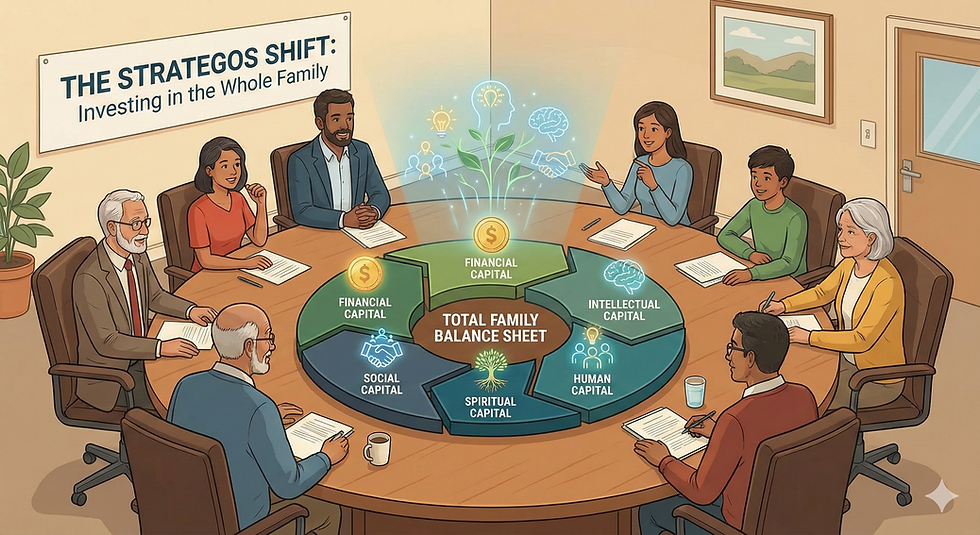
A high-functioning Family Council reviews the whole balance sheet.
How is our Human Capital performing? (Are we funding their education and growth?)
How is our Intellectual Capital growing? (Are we listening to their new venture ideas?)
How is our Social Capital deepening? (Are we connecting them to our network?)
Make sure your family doesn't make the same mistakes as eBay.


Comments